
Limerick City Directory Holdings
Limerick Township has no verified annual municipal city-directory run. That is the starting point for accurate historical work. Limerick is a township with smaller historic communities, including Linfield, and a person may appear in a regional Pottstown, Royersford, Norristown, or telephone directory only if the exact edition is first confirmed in a catalog. The most useful local shelf is the Limerick Township Historical Society library at the Isaac Tyson Hunsberger House. Its research material is physical, not a searchable online name database.
| Collection | Documented dates | Where held | Access |
|---|---|---|---|
| LTHS family files and card index | Collection circa 1900-2012 | LTHS, Hunsberger House | On-site alphabetical research files |
| LTHS obituary binders | 1938-2012 | LTHS | Four alphabetical copied-obituary binders |
| LTHS memorial cards | 1944-2007 | LTHS | Two alphabetical binders with a partial index |
| Shalkop and Franks funeral printouts | Burials about 1900-1950 | LTHS | On-site alphabetical decedent printouts |
| Regional directories and telephone books | Edition and date must be catalog-confirmed | Regional libraries or archives | Use only after confirming coverage |
The coverage table is deliberately a collection table, not an invented directory list. Church and cemetery transcriptions, family-history books, and a small Limerick deed collection add context at LTHS. They can establish a dated family or place lead, but none should be described as an annual roster of everyone in the Township. Note: A historical address or name is evidence from its own date, not proof of a current residence.
Why Limerick Directories Differ
A printed directory usually follows a postal locality, not a township boundary. That matters in Limerick city directory research because the same household can be associated with Linfield, Royersford, Pottstown, a rural delivery, or Limerick Township across different sources. Some Township households may never appear in a regional book. Confirm a title and edition before treating an omission as meaningful, then compare the address, spouse or family connection, age, street or rural route, and the locality printed in the source.
Federal census schedules give a second dated household view. Public schedules reach through 1950 as of 2026. The LTHS collection materials also caution that early Limerick population figures can include land later annexed by Royersford. A mismatch can therefore reflect a boundary or mailing label rather than a wrong family. This is why city directories are best used with deeds, tax material, census entries, probate records, and local historical files instead of being asked to settle every question alone.
Limerick Directory Files at LTHS
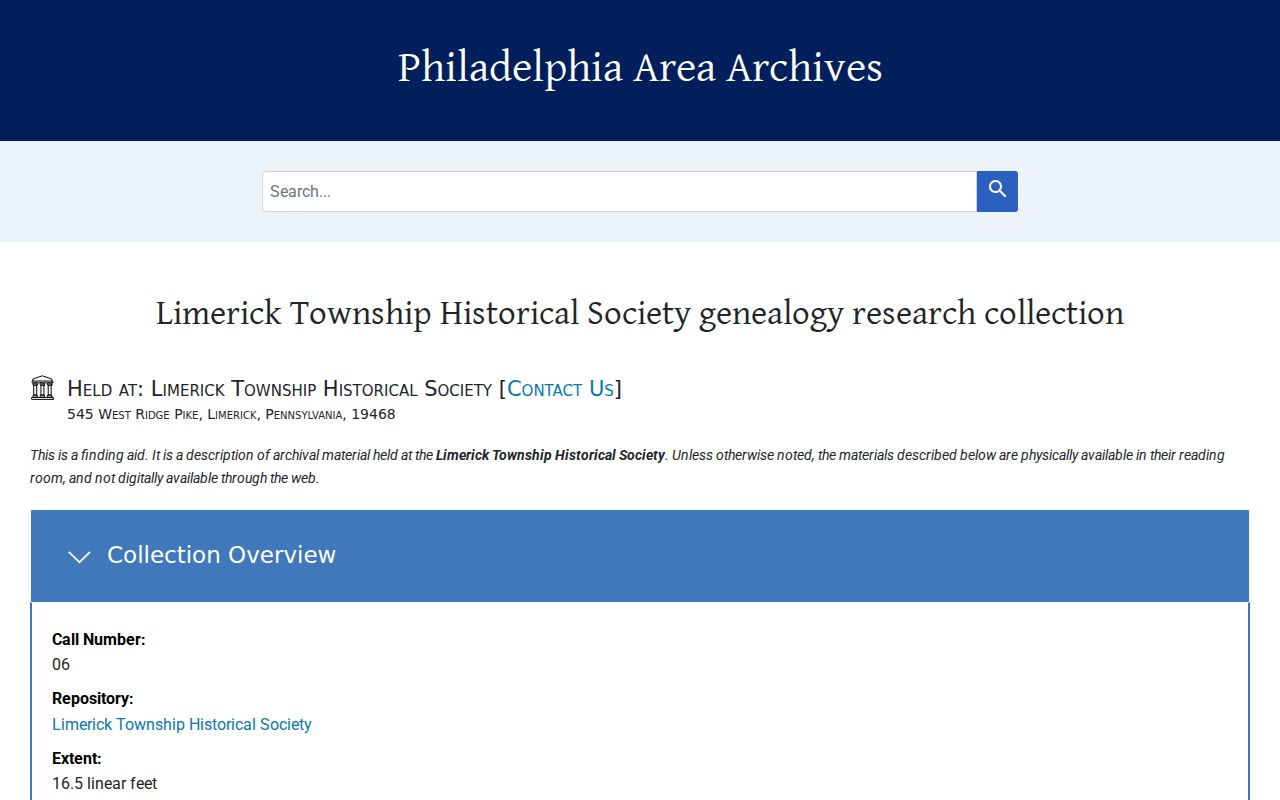
The University of Pennsylvania finding aid for LTHS genealogy research collection 06 describes 16.5 linear feet of material from about 1900 to 2012. The core name tool is an on-site card index leading to alphabetized Limerick family files. Those files can contain photographs, clippings, ephemera, research notes, and family trees. The finding aid also identifies on-site cemetery indexing and 28 binders compiled around 1973 with copied church records, tombstone inscriptions, and family histories.
The Historical Society’s collection information documents the local genealogy holdings and visiting arrangement.
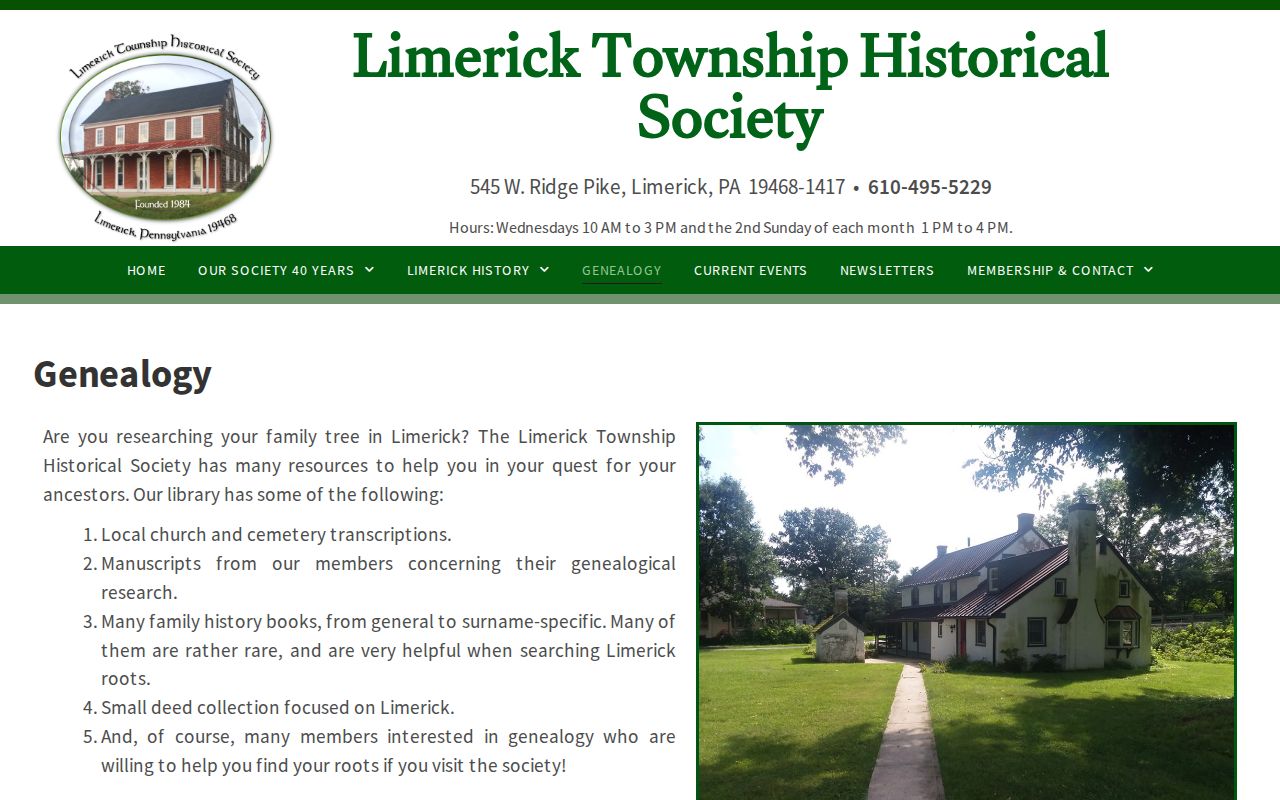
Use the collection as a surname and household research stop. LTHS is open Wednesdays from 10 a.m. to 3 p.m. and on the second Sunday from 1 p.m. to 4 p.m. Nonmembers pay a small admission, and remote research may carry a small hourly charge after a 15-minute lookup. Contact the repository before relying on a particular item or service.
Reading Limerick City Directory Leads
No digitized annual Limerick directory entry or printed abbreviation key was located in the research. The documented local entries are instead an alphabetical family-file card, copied obituary pages, memorial cards, and funeral printouts. Read each as a lead with a keeper, date, and record type. A surname file may preserve a family tree or clipping. A funeral printout can carry identity, dates and places, parents, spouse, burial information, or other historical detail. Sensitive facts still need careful, limited handling.
| Family-file card | Points to an on-site surname file with notes, images, clippings, or family-tree material. |
|---|---|
| Obituary binder | Provides an alphabetical death and family-history lead for the documented binder period. |
| Memorial card | Supplies a funeral or relationship lead, with only a partial index documented. |
| Funeral printout | May record the decedent, dates and places, family relationship, funeral, or burial fields. |
- Criss-cross directory
- A reverse directory organized by address rather than name. No authoritative Limerick-specific run was located.
- Householder index
- A name guide to the listed householders in a printed volume. It is not a full census of residents.
- Abbreviation key
- The legend that explains a particular printed book’s marks. No verified local scanned key was found, so do not assume one.
Limerick Cemetery and Church Binders
The 28 LTHS binders deserve separate attention because they combine copied church records, tombstone inscriptions, and family histories. Four copied-obituary binders cover 1938 through 2012, while two memorial-card binders cover 1944 through 2007. The finding aid also describes computer printouts from the Frank W. Shalkop and Charles J. Franks Sr. undertaker material for burials around 1900 through 1950. Together, these sources provide a real person-indexing layer for past Limerick families without claiming that a municipal city directory exists.
The online archival finding aid identifies the on-site indexes and collection scope.
Cross-check a binder result with a record close to the event, such as a probate docket, deed, cemetery transcription, or census schedule. A death or burial notice can help identify a family relationship, but it does not update a former address or establish a living person’s location.
Limerick City Directory Household Trail
Trace a Limerick household by changing sources when the evidence changes. Start with the address in the county assessment record and the recorded deed chain, then ask LTHS about the surname or property lead. If a regional city directory or telephone book is found, first verify that exact edition in a catalog and read it in its postal and township context. Compare every source against its date rather than carrying an old label forward.
- Record the street address, parcel identifier, legal description, and date from the county property and deed trail.
- Ask LTHS to check the family files, obituary binders, memorial cards, funeral material, church or cemetery transcriptions, and small deed collection that fit the date.
- Confirm any regional directory or telephone-book edition in a library catalog before using its listing as a Limerick household lead.
- Pair the dated listing with the relevant federal census schedule, county tax material, probate or marriage record, and local newspaper microfilm.
- Compare spouse names, street or rural route, age, family relationship, and Township or borough label before deciding the records concern one household.
A person who disappears from one record may have moved, died, changed a name form, fallen outside the publisher’s coverage, or been recorded under a different postal place. Preserve the uncertainty. The family files and obituaries are especially useful for a past household; modern address-keyed records belong on the Limerick Township street address directory.
Royersford Labels in Limerick Directories
Limerick’s record geography predates Montgomery County. The Limerick Township Historical Society places the Township on record in Philadelphia County in 1726, and Limerick became part of Montgomery County in 1784. Royersford then became a separate borough in 1879 and later annexed portions of former Limerick land. LTHS notes early population figures may include territory affected by annexations in 1904, 1909, and 1924, while another census source notes an annexation in 1926.
- 1726: Limerick is placed on record as part of Philadelphia County.
- 1784: Limerick becomes part of newly formed Montgomery County, matching the Recorder’s office-record start.
- 1879: Royersford becomes a separate borough from its former Limerick context.
- 1904, 1909, 1924, and 1926: Sources flag later annexation history, so a dated deed or plan must resolve an individual address.
The different dates are a warning against a one-size-fits-all boundary claim. For an older Limerick city directory lead, search the exact street, legal description, date, Linfield, Royersford, Montgomery County, and, when necessary, Philadelphia County. Use a contemporaneous deed, plan, map, tax item, or repository record to resolve the location. Note: A Royersford or Linfield label can be a historical or postal clue, not proof that a household moved.
County Archives for Limerick Directories
The Historical Society of Montgomery County in Norristown is the county-wide companion for a regional directory search. Its research library reports family and genealogy material, religious records, local history, county tax records, and newspaper microfilm, including the Norristown Times Herald. Researchers may visit, call, or email; archive items should be requested ahead so staff can pull them. Listed library hours are Monday, Tuesday, and Thursday from 10 to 5, Wednesday from 1 to 8, and the first Saturday from 10 to 2.
The Montgomery County Archives is the official historical-record counterpart. It welcomes walk-ins and maintains retrieval channels for vital, marriage, estate, civil, Recorder, and veterans materials, but it cannot certify documents. HSMC lists a $7 nonmember day fee, 50-cent nonmember copies, and remote research at $30 per hour plus copies. Check current catalog results and service terms before planning a visit or ordering research.
Using Limerick Directory Results Carefully
Historical city directory work is strongest when it creates a short, documented next step. Keep the exact source title, collection name, date range, page or folder reference, spelling, locality label, and the date of your own search. Ask the custodian about an original item when a copied note is incomplete. This approach avoids turning a family-history record into a current-person claim or confusing a tax mailing address with a physical place.
Personal research. Use historical material for lawful family, estate, or community research, and never use a record to stalk, harass, or harm anyone.
LTHS offers the best local route when the question concerns a past household, while county and regional repositories can test it against records held elsewhere. The honest answer is sometimes that no local annual directory exists. That gap is useful information because it directs research toward the sources that are actually documented.