
Limerick Township Previous Residents Sources
Previous residents leave different kinds of evidence in different eras. Begin with the source closest to the question. A deed chain is strongest for recorded ownership. Local obituary or funeral material can supply family context. A census schedule gives a dated household view. None of those sources, alone or together, creates a complete list of everyone who lived at an address.
| Source | Documented coverage | Where held | What the trail can show |
|---|---|---|---|
| Recorder deeds and land records | Office records from 1784 to present | Recorder portal or counter | Recorded ownership, legal descriptions, plans, and transfer leads |
| County property records | Current database, updated weekly | County property portal | Current situs, parcel, assessment facts, and a sale or deed lead |
| County probate | 1784–1987 docket books; computer records from 1988 | Register of Wills or Archives | Estate and personal-representative research leads |
| LTHS funeral printouts | About 1900–1950 burials | Limerick Township Historical Society | Decedent, family, funeral, and burial clues |
| LTHS obituaries | 1938–2012 | Limerick Township Historical Society | Death and family-history leads |
| Federal census | 1790–1950 public schedules | Authorized public repositories | Household snapshot at the census date |
Start with today’s parcel when the street address is known. Start with a dated obituary, estate, or census clue when the question is about a former household. The point is to follow one address backward in a documented order, not to fill an address with names from unrelated records.
Limerick Township Previous Residents Parcel Start
The Montgomery County Property Records service is the practical first stop for a Limerick Township address. Search by street address or parcel number, then save the situs address exactly as displayed, the parcel identifier, any deed book or page reference, last sale information, and the tax-map position. The County removed owner-name searching in 2022, so an address or parcel is the public entry route.
Keep three labels distinct. The situs is the physical street address associated with the parcel. The mailing address is where assessment correspondence goes and may belong to a post-office box, trustee, business, or another location. The legal description, such as a lot, subdivision, or plan reference, is the durable bridge from the assessment record to the deed. A mailing address is not evidence that someone lived at the property.
For a visual check, the Montgomery County interactive tax map helps relate a parcel to nearby streets and parcels. It is informational map data, not a boundary survey or a title opinion.
Limerick Township Previous Residents Deed Chain
The backward deed chain is the core of a previous residents search for an address. The Montgomery County Recorder of Deeds keeps land records dating to 1784. After the current parcel is identified, use the Recorder index to find the newest deed, record each party’s role and the legal description, then use the seller or prior owner and the earlier document reference to continue. This traces recorded transfers, not every past household.
- Locate the current property record by address or parcel and copy the parcel ID, situs, legal description, sale lead, and tax year or data date.
- Sign in to the Recorder Public Access System and search the parcel, address, party, document number, or book and page that the available record supports.
- Identify the newest deed and distinguish the grantee, the person receiving an interest, from the grantor, the person transferring it.
- Use the prior party, legal description, and document reference to find the preceding transfer rather than relying only on a similar street number.
- Repeat each step in a log until the trail reaches an older book, plan, different locality label, or access limitation that needs counter or archive help.
- Grantor and grantee
- The grantor transfers an interest. The grantee receives it. Those roles are read from a particular document and date.
- Chain of title
- A sequence of recorded transfers connecting one interest in property to earlier transfers. It is not a roster of occupants.
- Legal description
- The lot, plan, subdivision, or other property language used to connect a deed to a parcel when street labels change.
Limerick Township Past Household Access
The Recorder’s 1784 date is an office-history date, not a promise that every early Limerick Township deed is digitized, address indexed, or freely viewable. The public system requires an account to reach Search Public Records. The County says ordinary document images viewed remotely require a subscription, priced at $25 for a calendar day or $300 per month. Plain copies and certified electronic copies use separate rules, and a certified electronic copy is listed at $10.50.
Those numbers matter when a past-household trail needs proof from a specific instrument. The free index can identify a document and its recorded date. If the image is necessary, use the stated subscription path, the e-certified option when appropriate, or the Recorder counter. The office can also help with historical books, plans, and book-page formats. A plan can resolve a lot or subdivision when a modern street label is not enough.
The Recorder’s Historical Research Resources page points house-history researchers to the County Archives, historical societies, maps, and other archival paths.
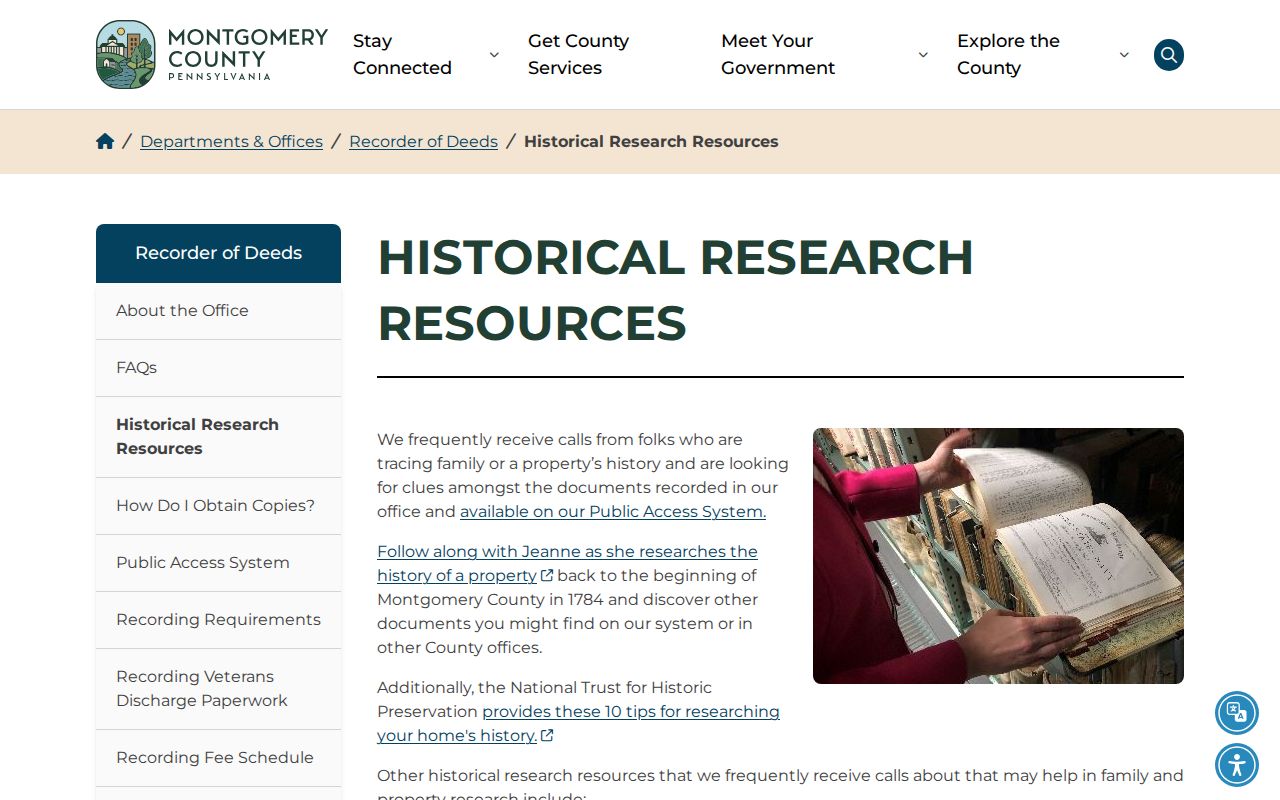
Use the page as a handoff when an index result reaches an older record format. It reinforces that a property history requires several custodians, not one screen.
Note: The Recorder’s public index is a document-finding tool; a recorded name or mailing address should not be treated as proof of who lived there.
Limerick Township Past Household Trail
Ownership is only one layer of past residents research. The Limerick Township Historical Society at the Hunsberger House holds a local, on-site research collection with family files, church and cemetery transcriptions, a small deed collection, obituary binders, memorial cards, and funeral material. Its holdings supply historical family clues that the modern property database cannot supply.
The detailed LTHS finding aid documents alphabetical family files, copied obituaries from 1938 through 2012, memorial cards from 1944 through 2007, and funeral printouts for burials around 1900 through 1950. Treat every entry as a lead that must be placed in time. It may point to a relative, burial, former locality, or source to request, but it is not a public current-person locator.
Limerick has no verified annual municipal directory run and no verified local criss-cross run. If a catalog confirms a regional Pottstown, Royersford, or telephone directory edition, read it in its postal and municipal context. The local collections themselves are described on the Limerick Township city directories page.
Limerick Township Past Residents Census Pairing
Pair a confirmed directory, funeral, or property clue with the closest public federal census date. The latest public schedule is 1950. A census can show a household at its enumeration date, while a deed can show a recorded transfer and an obituary can suggest a later family connection. Compare street or rural-route wording, names, ages, spouse names, and locality before treating them as the same household.
- Place the property record or deed in a date range using its recorded date and legal description.
- Check the relevant census schedule for the period, allowing for spelling variants and rural or postal labels.
- Use LTHS family files, obituaries, memorial cards, or funeral material to test family relationships shown in the household.
- Confirm a transfer or estate relationship through the Recorder, Register of Wills, or the correct archive channel.
Royersford’s relationship to Limerick creates a special caution. Limerick historical material says early population figures can include territory later annexed by Royersford. A place label can change without proving that a household moved, so use the parcel, plan, and date together.
Limerick Township Past Household Archives
The Montgomery County Archives retrieval route is the county fallback when a past-household trail needs older vital, marriage, estate, civil, Recorder, or veterans material. The Archives welcomes walk-ins and describes the available archival paths. It does not certify documents, so certification must come from the department legally responsible for the record.
The Archives page can help choose between an old record request and an in-person visit. It is especially useful after a recorded owner appears to be deceased, when probate or older county vital material may provide a dated relationship clue.
Montgomery County Archives explains its archival retrieval paths in the source shown below.
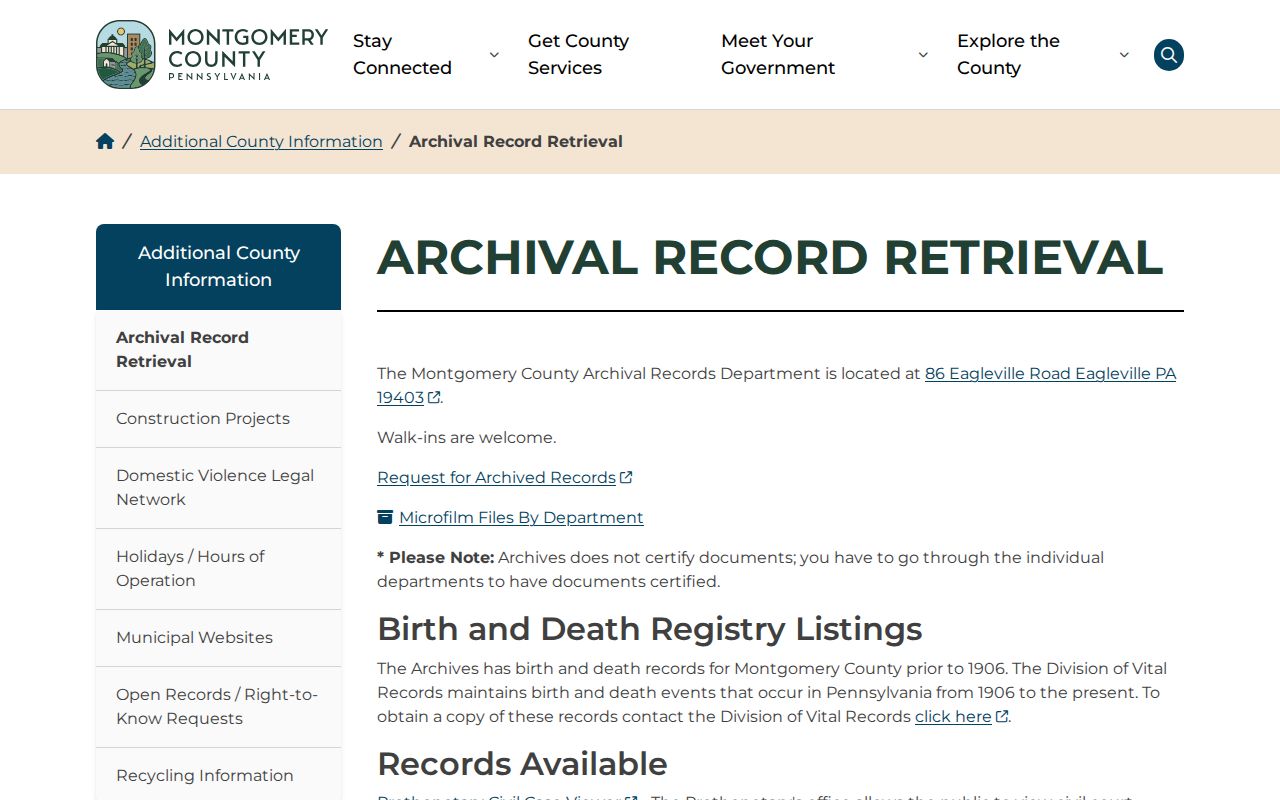
Bring the known name, date range, record type, property reference, and any docket or book-page number. A specific request is more useful than asking for every record about an address.
Limerick Township Past Property Timelines
Township Planning and Zoning files can date changes to a property even when they do not identify a household. Limerick code requires records of applications, plans and information, permits, special conditions, and nonconforming-use information. The Planning and Zoning office and the Township forms list identify construction, zoning, drainage, sewer, road-occupancy, subdivision, hearing, and verification record types.
For a dated file, request a particular property, parcel, record class, and interval through the Township’s Right-to-Know process. An application is not an issued permit, and an issued permit is not proof of completed work or residence. These files date a project history rather than every person connected with the address.
Limerick Township Previous Residents Place Names
A historic address can use more than one governmental or postal label. Limerick was recorded in Philadelphia County in 1726 and became part of Montgomery County in 1784. The LTHS local-deed material includes records from 1783 through 1994, so the earliest part of a trail may need Philadelphia County context before a Montgomery County Recorder search begins.
Royersford was originally within Limerick, became a separate borough in 1879, and later annexed parts of Limerick. Sources describe annexations in several years, including 1904, 1909, and 1924, while a 1930 census report notes an annexation in 1926. Do not choose one date for every address. Search Limerick Township, Linfield, Royersford, the legal description, and the date-specific map or plan that applies.
Limerick Township Previous Residents Limits
A previous residents trail is best used for house history, family history, estate questions, and other lawful research. It does not authorize tracking a living person or publishing a household list. Vehicle, utility, and delivery data are not substitutes for a county land record. Protected addresses, restricted vital material, sealed court files, and redacted information must remain protected.
When a trail ends, preserve the last confirmed source and ask the responsible office whether a counter, mail, phone, archive, or narrowly scoped Right-to-Know request exists. The absence of a digitized result does not prove a record was lost. No authoritative Limerick-specific courthouse fire or wholesale records-loss event was located, and the Recorder’s missing-book ranges should not be described as proof that all local records disappeared.
Lawful use. Use Limerick Township previous residents research for personal, lawful house and family history. Do not use names or records to stalk, harass, threaten, or harm anyone.